Practical
Yosemite Weather by Month: Temperatures, Snow, Waterfalls and Road Seasons
Yosemite weather depends less on the calendar than on altitude. The park covers nearly 1,200 square miles of the Sierra Nevada, and the National Park Service gives its elevations as running from about 2,000 feet to 13,000 feet. Yosemite Valley, where most visitors spend their day, sits at 4,000 feet. Tuolumne Meadows, up on the Tioga Road, sits at 8,600 feet. On the same July afternoon the Valley averages 89°F and Tuolumne Meadows 72°F, and in January the meadows drop to an average low of 13°F while the Valley floor hovers just below freezing.
The second thing to know is that almost all of Yosemite’s rain and snow comes in one half of the year. The park says it receives 95% of its precipitation between October and May, and over 75% between November and March. Summers are long and dry; winters are cool and wet. That pattern drives everything a visitor cares about: when the waterfalls roar, when the high roads open, when chains are needed and when the trails are clear.
Yosemite Valley weather by month
The National Park Service publishes average temperatures and precipitation based on 1991 to 2020 records. These are averages, not forecasts; any given week can be warmer, colder, wetter or drier.
| Month | Average high | Average low | Precipitation |
|---|---|---|---|
| January | 48°F (9°C) | 29°F (-2°C) | 7.0 in (177 mm) |
| February | 51°F (11°C) | 30°F (-1°C) | 6.5 in (165 mm) |
| March | 57°F (14°C) | 34°F (1°C) | 5.5 in (139 mm) |
| April | 63°F (17°C) | 38°F (3°C) | 3.2 in (81 mm) |
| May | 71°F (21°C) | 45°F (7°C) | 1.9 in (49 mm) |
| June | 81°F (27°C) | 51°F (11°C) | 0.5 in (12 mm) |
| July | 89°F (32°C) | 57°F (14°C) | 0.3 in (7 mm) |
| August | 89°F (32°C) | 57°F (14°C) | 0.2 in (4 mm) |
| September | 83°F (28°C) | 51°F (11°C) | 0.4 in (10 mm) |
| October | 71°F (22°C) | 41°F (5°C) | 1.6 in (40 mm) |
| November | 56°F (13°C) | 33°F (0°C) | 4.1 in (103 mm) |
| December | 46°F (8°C) | 28°F (-2°C) | 5.6 in (142 mm) |
Three things stand out. January is the wettest month, with about seven inches of rain or snow, while July and August get almost none. The daily swing is large all year: a July day climbs to 89°F but the night falls to 57°F, so even a summer visit needs a warm layer for the evening. And the shoulder months are mild: May and October share the same 71°F average high, which is why many people consider them the most comfortable months in the Valley.
Tuolumne Meadows and the high country
Up at 8,600 feet the picture changes completely. The park’s averages for Tuolumne Meadows:
| Month | Average high | Average low |
|---|---|---|
| January | 41°F (5°C) | 13°F (-11°C) |
| February | 39°F (4°C) | 12°F (-11°C) |
| May | 54°F (12°C) | 27°F (-3°C) |
| June | 65°F (18°C) | 33°F (0°C) |
| July | 72°F (22°C) | 39°F (4°C) |
| August | 70°F (21°C) | 37°F (3°C) |
| October | 57°F (14°C) | 26°F (-3°C) |
| December | 40°F (4°C) | 12°F (-11°C) |
Even in July the average night at Tuolumne Meadows is 39°F, cold enough for frost on a clear night. In winter you cannot drive there at all, because the Tioga Road is closed (more on that below). The summit of Half Dome, at 8,800 feet, behaves like the high country too: the park says it is typically 15°F to 20°F cooler than Yosemite Valley, with wind common.
The lesson for packing is simple. If your day includes Glacier Point, the Tioga Road or a long climb out of the Valley, plan for temperatures well below what the Valley forecast says.
Where the snow falls
The park describes a Mediterranean climate: cool, wet winters and long, dry summers. Most precipitation falls as snow that builds up above 6,000 feet, and the park puts Yosemite’s average winter snow line at 5,700 feet. Most of the park is under snow from about November through May. Yosemite Valley, at 4,000 feet, sits below that average line, which is why the park says the Valley can be rainy or snowy in any given winter storm. A cold storm whitens the cliffs to the Valley floor; a mild one brings rain.
That snowpack is the park’s water tank. It melts slowly through spring and early summer and feeds the rivers and waterfalls long into the dry season. The park notes that the same mountain effect that squeezes snow out of Pacific storms is the primary reason half of California’s total water supply originates in the Sierra Nevada.
Winter: December to February
Winter is the quietest and, for many, the most beautiful season in Yosemite Valley. Average highs are 46°F to 51°F and lows hover just under freezing, with most of the year’s precipitation falling between November and March.
What winter brings:
- Snow on the cliffs and an ice cone under the falls. The park says Yosemite Falls flows approximately November through July. In winter, look for the ice cone that builds at the base of the upper fall. All the waterfalls collect frost along their edges on cold nights.
- Horsetail Fall. This small fall pours off the east side of El Capitan, flows approximately December through April, and on rare evenings in mid- to late February glows orange in the sunset. The park stresses that it happens only on clear evenings when the fall is flowing; even some haze can kill the effect. Crowds are now large enough that viewing restrictions apply each February: visitors park at Yosemite Falls parking and walk 1.5 miles each way to the viewing area near El Capitan Picnic Area. No reservation was required to visit in February 2026.
- Snow sports. Badger Pass Ski Area, whose base is at 7,200 feet, runs downhill skiing and snowboarding from mid-December through March, conditions permitting. Marked winter routes for cross-country skiing and snowshoeing generally have enough snow from mid-to-late December through mid-March, and rangers may lead free snowshoe walks from Badger Pass in that period. The Curry Village Ice Rink is open from mid-November to mid-March.
- Closed high roads. The Tioga Road and the road to Glacier Point are closed to cars, and so is the Mariposa Grove Road (see the road calendar below).
- Chains. The park tells visitors to expect chain requirements from November through March, even if they only plan to visit Yosemite Valley.
Winter is also when most rockfalls happen, during intense rain, snowmelt and freezing temperatures, and when some trails partly close. The lower Mist Trail along Vernal Fall shuts for falling ice and rock, and the Four Mile Trail closes below Union Point after heavy snow.
Spring: March to May
Spring is waterfall season. As temperatures rise the snowpack melts, and the park says peak runoff typically happens in May or June. On average, the park’s hydrology page puts the waterfall peak in mid-May, but it moves with the snow: much earlier in years with little snowpack, such as 2015, and later in big snow years, such as 2011. In heavy years, high flows last longer, giving several weeks of thunder either side of the peak.
What spring brings:
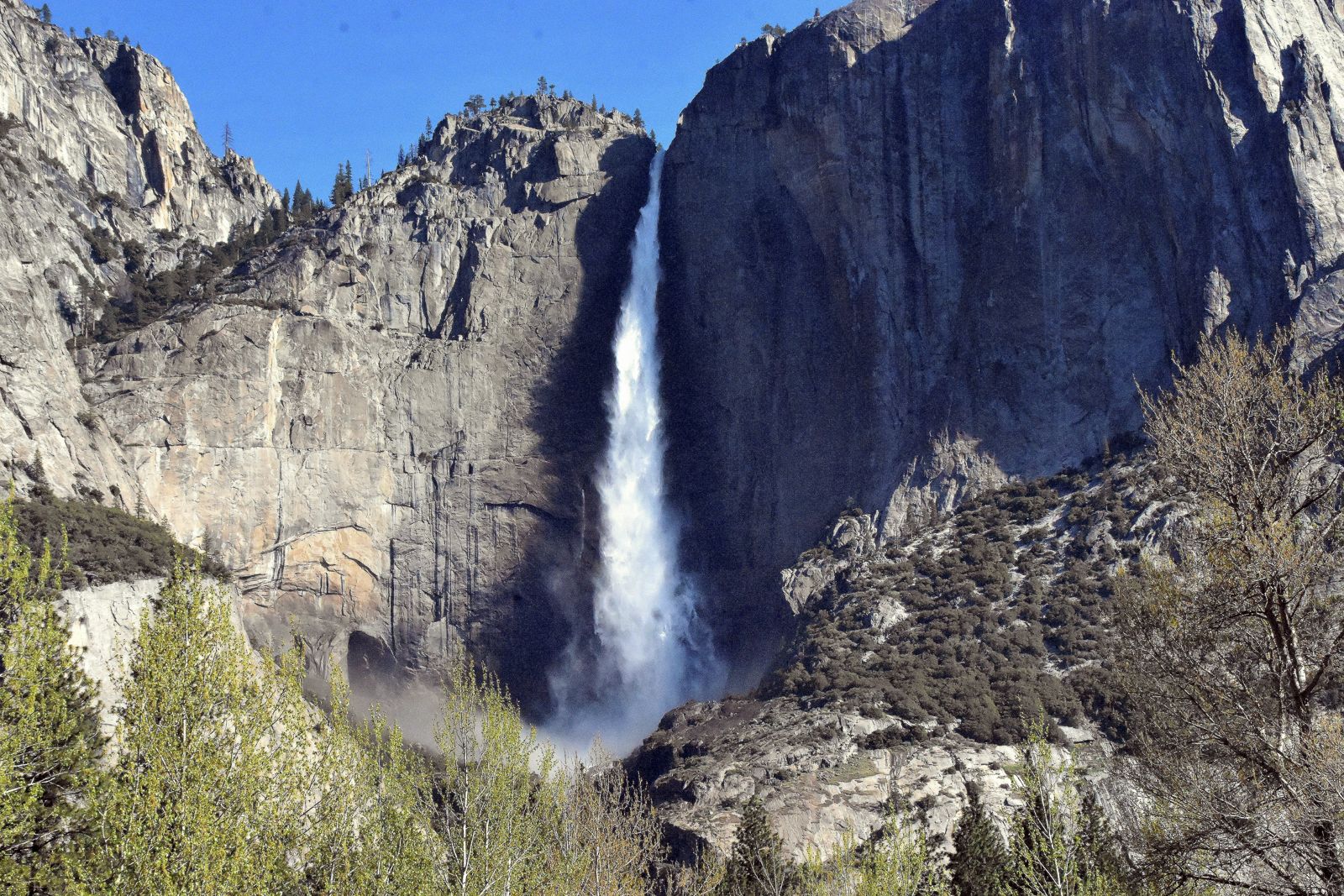
- Every fall running at once. Yosemite Falls roars from April through June. Sentinel Falls and Ribbon Fall, which flow only from approximately March through June, are at their best. Bridalveil Fall, the park says, thunders in spring; walk to its base and expect to get wet.
- Moonbows. On full-moon nights in peak waterfall season, April to June, the moonlight is bright enough to make rainbows in the mist of Upper and Lower Yosemite Falls.
- Wildflowers. Blossoms open in March at the park’s west edge in the Merced River canyon, and by mid-May many more are in bloom in Yosemite itself.
- Mild days, cold nights. April averages 63°F by day and 38°F at night in the Valley; May reaches 71°F.
The catch is the high country. Clearing of the Tioga Road begins on or about April 15 each year and usually takes one to two months, and the park says predicting the opening date is not possible, because April and May weather can slow plowing. Glacier Point Road likewise usually stays closed into late May or early June. The Mariposa Grove shuttle starts no earlier than April 15. In spring, chains are needed less often than in winter, but the park still lists April as a month when they can be required.
Summer: June to August
Summer is hot and dry in the Valley, cool and green in the high country, and busy everywhere. The Valley averages 81°F in June and 89°F in July and August, with almost no rain. Tuolumne Meadows tops out around 72°F.
What summer brings:
- The whole park open. The Tioga Road, the Glacier Point Road and the Mariposa Grove shuttle all run, so the high country, Glacier Point and the giant sequoias are all within reach of a day trip.
- Fading waterfalls. The falls are still strong in June, but the park warns that some, including Yosemite Falls, are often only a trickle or completely dry by August. Lower Yosemite Fall is often dry from late July or August through October.
- High-country flowers. In late June the meadows at Tuolumne turn pink with shooting stars, and at the highest elevations flowers sometimes wait until early July for the snow to melt.
- Afternoon thunderstorms. The park says thunderstorms are most common June through September and most often in the afternoon. From July through September the North American monsoon can push moisture from the Gulf of California into the Sierra Nevada.
Summer also brings the worst traffic. Yosemite welcomes over four million visitors a year, and in summer the park warns of delays of an hour or more at entrance stations and two to three hours in Yosemite Valley. Day visitors driving to the Valley should arrive before 9 am, after which parking is usually full.
Fall: September to November
September is still summer in all but name, with an 83°F average high in the Valley. October cools to 71°F by day and 41°F at night, and November drops to 56°F with the first serious storms.
What fall brings:
- Low or dry waterfalls. This is the season’s trade-off. In late October 2026, for example, the park reported Yosemite Falls dry while Vernal, Nevada and Bridalveil Falls were low. Storms in late fall rejuvenate some of the falls.
- Clearer trails and fewer people than summer, and the core of the Milky Way, which the park says is easily visible on moonless nights from July through October.
- The high season winding down. The Half Dome cables normally come down the day after the second Monday in October. The Tioga Road and the Glacier Point Road usually close sometime in November, and early storms can close them sooner: the Tioga Road was temporarily closing on Wednesday, October 21 at 5 pm in 2026 for a snow forecast.
- The first chains. The park says chains are needed less often in October and rarely in September, but they can be required at any time once storms arrive.
Fall is also fire and smoke season in the wider region. The park notes that hazy or smoky conditions are always possible, from fires elsewhere or from prescribed burns in the park.
The road calendar
Weather decides which parts of Yosemite you can drive to. The park’s own seasonal pattern:
| Road | Usual season | When closed |
|---|---|---|
| Tioga Road (Highway 120 through the park) | Late May or June to November | No car access to Tuolumne Meadows or the east entrance |
| Glacier Point Road | Late May or early June to November | First five miles open to Badger Pass, mid-December through March |
| Mariposa Grove Road and shuttle | No earlier than April 15 to about November 30 | Walk the Washburn Trail, two miles each way |
| Wawona Road (Highway 41) | All year | Chains may be required |
| El Portal Road (Highway 140) | All year | Chains may be required |
| Big Oak Flat Road (Highway 120 from the west) | All year | Chains may be required |
| Hetch Hetchy Road | All year, sunrise to sunset | Closes when it is snowing or snow is forecast overnight |
Tire chains: what the rules really mean
Chain rules catch many visitors out. The park’s guidance:
- When: chains are often required inside and outside the park from November through March, less often in October and April, and rarely in September or May.
- Who: when chain controls are in effect, every vehicle must carry chains, including four-wheel drive and rental cars. The park stresses that rental cars are not exempt, even with all-season tires.
- Where: the higher roads get them more often. Chains are required on the Wawona Road (Highway 41), Big Oak Flat Road (Highway 120) and Badger Pass Road more often than on the El Portal Road (Highway 140) or roads within Yosemite Valley.
- How fast: the speed limit within chain control areas is 25 mph.
- The penalty: failing to put on chains when required can bring a citation of up to $5,000.
Chains are rarely available to rent, so buy a set that fits your tires before you go. The alternative the park suggests is to park at a YARTS bus stop on Highway 140 outside the park, below the chain controls, and ride the bus in (a fee applies). For live conditions inside the park, the recording at 209/372-0200 (press 1, then 1) is the same one park staff use.
Joining a guided trip is another way round it: on a day trip from San Francisco the driving, and the chains, are someone else’s job.
Thunderstorms and lightning
Summer afternoons in the high country often build into storms, and the park takes lightning seriously. In July 1985, lightning at Half Dome killed two people and injured three others. The park’s advice:
- Start early. Thunderstorms are most common in the afternoon; plan to reach summits and exposed ridges before noon.
- Read the sky. Towering cumulus clouds building through the day are an early warning.
- Thunder means go. If you hear thunder, the storm is within 10 miles. Get to a substantial building or a hard-topped vehicle.
- If caught out: avoid viewpoints, lone trees, water and metal; spread a group at least 50 feet apart; stay in a safe place until 30 minutes after the last thunder.
Picking your month
There is no single best month; there is a best month for what you want. Using the park’s own seasons:
- For waterfalls: May and June, when runoff peaks. Mid-May is the long-run average peak, earlier in dry years.
- For the whole park open: late June to September, when the Tioga Road, Glacier Point Road and the grove shuttle normally all run.
- For comfortable hiking in the Valley: May, late September and October, with average highs of 71°F to 83°F, though the falls are low by fall.
- For high-country hiking: July to September, after the snow melts and before the November closures.
- For quiet and snow: December to February, if you accept closed high roads and carry chains.
- For Horsetail Fall: mid- to late February, with luck and a clear sky.
- For stars: moonless nights from July through October for the Milky Way; full moons from April to June for moonbows.
Whatever you choose, check the park’s current conditions page and the forecast in the days before you go. Our guide to hiking in Yosemite sorts the trails by season, and our list of things to do in Yosemite covers the viewpoints and activities that suit each time of year. For trips that handle the driving, see all Yosemite tours, and for prices, reservations and entry rules, our guide to entrance fees and reservations and the FAQ.
Frequently asked questions
What is the weather like in Yosemite in summer?
Hot and dry in Yosemite Valley, which averages 81°F in June and 89°F in July and August, with nights around 51°F to 57°F and almost no rain. Tuolumne Meadows, at 8,600 feet, averages about 72°F by day and 39°F at night in July. Afternoon thunderstorms are common in the high country.
Does it snow in Yosemite Valley?
Yes, but not every storm. The park says most of Yosemite is under snow from about November through May, and Yosemite Valley, at 4,000 feet, can be rainy or snowy in any given winter storm. The average winter snow line is 5,700 feet, a little above the Valley floor.
When are Yosemite’s waterfalls at their best?
In spring. Peak runoff typically happens in May or June, and the long-run average peak is mid-May. Yosemite Falls is often a trickle or dry by August, and Lower Yosemite Fall is often dry from late July or August through October.
Do I need tire chains for Yosemite?
From November through March, the park says to expect chain requirements even if you only visit Yosemite Valley. Every vehicle must carry chains when controls are in effect, including four-wheel drive and rental cars, and the fine for ignoring them can reach $5,000.
When does the Tioga Road open?
Clearing begins on or about April 15 each year and usually takes one to two months, so the road typically opens in late May or June and closes sometime in November. The park says the exact date cannot be predicted, because spring storms slow plowing.